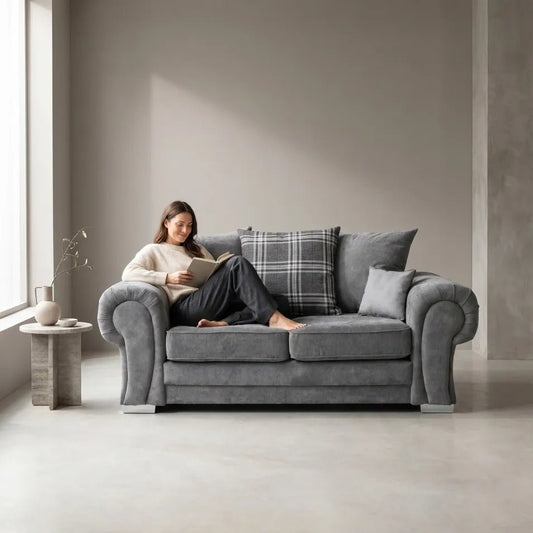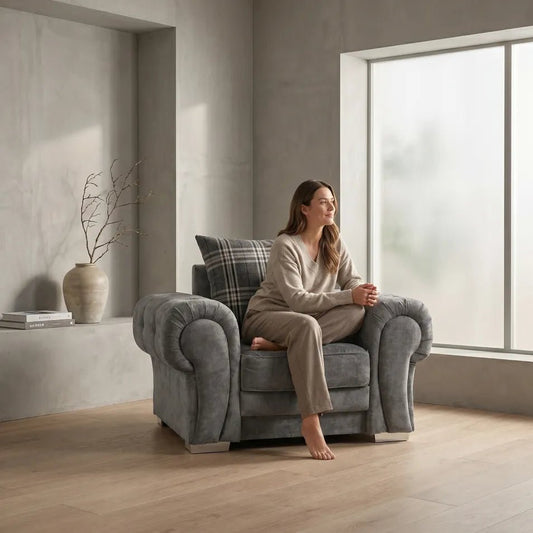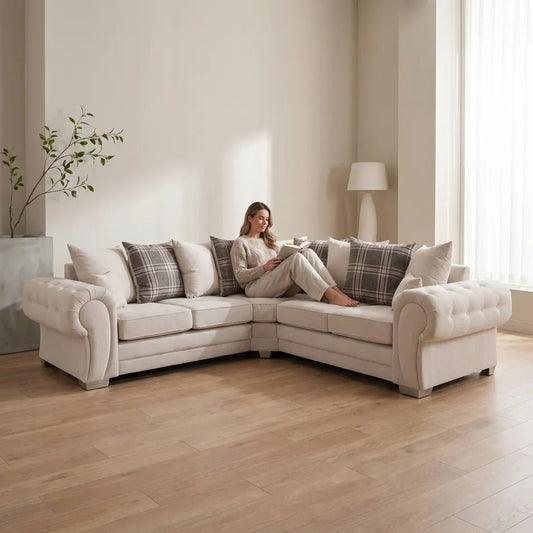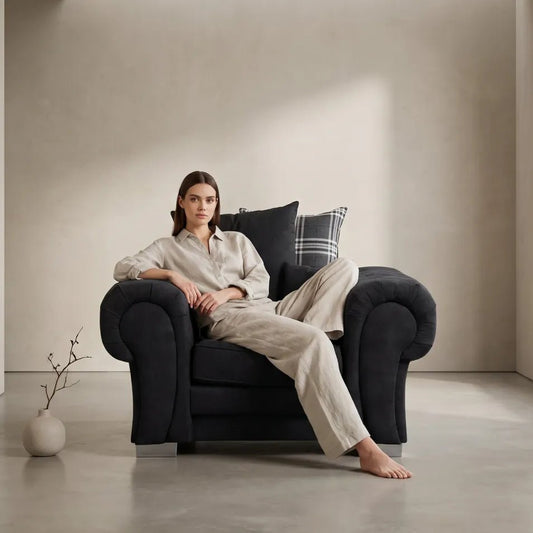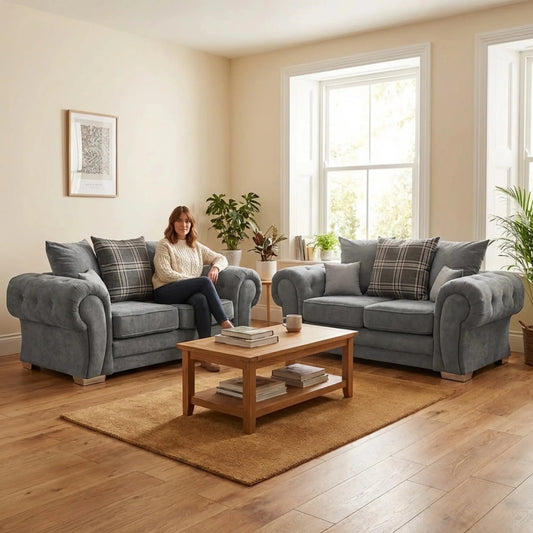
A scatter back sofa is a sofa where the back cushions are loose and individual — separate cushions that rest against the sofa backrest rather than being attached to the frame. On a fixed-back sofa, the back cushions are sewn or fixed directly to the frame and cannot be removed or repositioned. On a scatter back sofa, each cushion is a separate, independent piece that can be arranged, stacked, rearranged or removed entirely.
The term "scatter" refers to the way the cushions sit on the sofa — they are placed rather than fixed, and the arrangement changes naturally with daily use. In practice, a scatter back sofa has three to seven individual back cushions (depending on the size and design) that together fill the backrest area and provide a relaxed, informal sitting support.
Scatter back sofas are also called loose-back sofas or scatter cushion sofas. All three terms refer to the same construction — loose, removable back cushions against a fixed frame. The sofa seats are typically fixed (attached to the frame) on a scatter back design; it is the back cushions specifically that are loose and repositionable.
The difference between a scatter back and a fixed back sofa is more significant than it first appears. It affects how the sofa looks, how it feels to sit on, how it behaves over daily use and what kind of household it suits. Here is the full picture.
A scatter back sofa has an inherently relaxed appearance — even when the cushions are neatly arranged, the fact that they are individual pieces gives the sofa a casual, lived-in quality that fixed-back designs cannot replicate. When the cushions are slightly disarranged after use — tilted, overlapping, informally stacked — the sofa looks like a room that is comfortable and used rather than staged. This quality is precisely what many households want from their main living room sofa.
A fixed-back sofa has a more structured, consistent appearance. The cushions retain their position and shape regardless of use, and the sofa looks the same at 7pm after a day of use as it did at 8am. This structured quality suits more formal rooms, households where appearance is maintained actively, and rooms that are viewed frequently from angles where the sofa is a prominent visual element.
Scatter back cushions move with the occupant rather than holding a fixed position. When you lean into a scatter back sofa, the individual cushions respond to your body shape — they give, compress and reform around you rather than presenting a fixed, uniform surface. This creates a different kind of comfort from a fixed-back sofa — deeper, more enveloping, more suitable for extended lounging. It is the quality that makes scatter back sofas the most popular choice for households where the sofa is used for film watching, relaxing and casual daily living.
Fixed-back sofas provide a more consistent sitting position — the back support is the same regardless of where on the sofa you sit or how you are positioned. This consistency suits households where the sofa is used for more upright activities — dining at a low table, working on a laptop, extended reading in an upright position.
The practical flexibility of individual scatter cushions is one of the most underappreciated features of this sofa style. Individual cushions can be rotated between positions to distribute wear evenly across all cushions — extending the life of each cushion significantly compared to a fixed cushion in a single, permanent position. A scatter back sofa's seat cushions can often be swapped between positions as well. This rotation and redistribution of use is simply not possible on a fixed-back design where the cushions are sewn into place.
The cushions can also be rearranged for different use cases — propped against the armrests for reading in a partially lying-down position, arranged across the seats to create a wider lounging surface when lying along the full sofa length, or stacked to one side when more sitting space is needed. A scatter back sofa adapts to different uses in a way a fixed-back design cannot.
The three main sofa back styles each suit different households, different rooms and different lifestyles. Here is the complete honest comparison.
| Scatter back | Fixed back | High back | |
|---|---|---|---|
| Back cushions | Loose, individual — fully removable and repositionable | Attached to frame — cannot be removed or repositioned | Fixed tall backrest — structured and consistent |
| Appearance | Relaxed, casual, lived-in | Neat, structured, always consistent | Formal, tall profile, strong visual presence |
| Sitting comfort | Enveloping, adaptable — cushions respond to body | Consistent — same support regardless of position | Full head and neck support — better for taller users |
| Maintenance | Fluff and rotate weekly to maintain loft | Low — cushions hold shape without intervention | Very low — fixed structure maintains itself |
| Cushion wear distribution | Excellent — rotate between positions to distribute | Fixed — most-used areas wear faster than others | Fixed — structured backrest wears evenly but cannot be adjusted |
| Best for | Family living rooms, casual lounging, film watching, relaxed interiors | Formal rooms, households wanting consistent neat appearance | Taller users, extended upright sitting, formal rooms with high ceilings |
| Choose if | Comfort and relaxed look matter more than consistent neatness | Neat appearance without daily maintenance is the priority | Full back support, formal look or taller household members |
The quality of a scatter back sofa's cushion filling determines how long the cushions maintain their shape and loft under daily use. This is the specification detail most people overlook when choosing a scatter back sofa — and the one that most significantly affects how the sofa looks and feels after one, three and five years of use.
The most widely used filling in scatter back cushion designs. High-quality polyester fibre gives the cushions their loft, weight and soft feel. Good quality fibre filling maintains its shape well with regular weekly fluffing — lower quality fibre compresses more quickly and is harder to restore once compressed. When choosing a scatter back sofa, the quality of the fibre fill is more important than the quantity — a well-made fibre cushion with good resilience lasts significantly longer than a cheaper alternative filled with the same weight of lower-grade material.
A foam core wrapped in polyester fibre. The foam provides structural resilience — it returns to shape after compression more readily than pure fibre — and the fibre wrapping gives the cushion the soft outer feel of a pure fibre design. Fibre-wrapped foam cushions typically hold their shape longer than pure fibre without regular fluffing, while retaining the soft, relaxed feel of a scatter back design. A good choice for households where the sofa sees very heavy daily use and fluffing frequency is likely to be limited.
The most luxurious filling option for scatter back cushions — genuine duck feather or down filling creates the softest, most enveloping scatter back cushion feel available. Feather cushions require more active maintenance than fibre or foam — they need to be plumped daily rather than weekly to maintain their shape — but the comfort level and the quality of the sitting feel are unmatched by synthetic alternatives. Premium scatter back sofas with feather-filled cushions are the closest domestic equivalent to a hotel bed — deeply comfortable, very forgiving, and rewarding of consistent care.
Yes — all sofa cushions compress with regular use, and scatter back cushions are no exception. The question is not whether they compress but how quickly and how completely, and how much of that compression is recoverable with regular care.
Scatter back cushion filling — fibre, foam or feather — compresses under the weight and warmth of a person sitting or leaning against it. Over time, repeated compression reduces the resilience of the filling material, and the cushion no longer returns fully to its original shape after use. This is a normal characteristic of all upholstered seating, not a defect. The rate of compression depends on the quality of the filling material, how heavily the cushion is used, whether it is rotated between positions, and how consistently it is maintained.
Fluffing a scatter back cushion — shaking and squeezing it to redistribute the filling and reintroduce air into the material — is the single most effective maintenance action for maintaining cushion loft. A quality fibre-filled scatter back cushion that is fluffed weekly and rotated regularly will maintain adequate loft for years of daily use. The same cushion that is never fluffed will compress significantly within the same period and be much harder to restore. Regular fluffing is not optional maintenance for a scatter back sofa — it is the primary care requirement of the style.
Each scatter back cushion wears at the rate determined by how frequently it is used in a contact position. A cushion that is always in the same position — the most-used seat on the sofa — compresses faster than one that is rotated between positions. On a 3-seater scatter back sofa with five back cushions and three seat cushions, rotating the cushions between positions every few weeks distributes use evenly across all cushions and extends the effective life of each one significantly. Most scatter back sofa owners do not rotate cushions and then find that specific cushions wear much faster than others — this is avoidable with a simple rotation habit.
After years of heavy daily use, fibre filling eventually loses sufficient resilience that regular fluffing cannot fully restore the cushion's original loft. At this point, the scatter back cushions can typically be refilled — replacement filling inserts are available from upholstery suppliers and extend the sofa's life significantly at low cost. This is an advantage of the scatter back style specifically: on a fixed-back sofa with attached cushions, compression is a permanent characteristic of the sofa that cannot be addressed without reupholstering. On a scatter back sofa, the loose cushions can be individually refilled or replaced.
The care requirement for a scatter back sofa is simple and consistent — regular attention to cushion maintenance is the primary ongoing task. Here is the complete routine.
Fluff every back cushion individually — shake vigorously to redistribute the filling, then squeeze and press the cushion from multiple sides to reintroduce air into the filling material. A well-fluffed scatter back cushion should feel plump and resilient immediately after fluffing. Rotate the cushions between positions — swap the most-used cushions (typically the centre positions) with the least-used (typically the end positions). This takes approximately five minutes per sofa and has the single greatest impact on how long the cushions maintain their appearance and comfort.
Vacuum the sofa surface — seat cushions, back cushion faces and the sofa frame fabric — using a soft brush attachment on a low to medium suction setting. This removes dust, crumbs and surface debris before they settle into the fabric pile. Pay particular attention to the crevices between the seat and back cushion areas where debris collects most readily. Rotate seat cushions at the same time as back cushions to distribute seat wear evenly.
Blot liquid spills immediately with a clean dry cloth — press firmly without rubbing. On chenille fabric, rubbing a spill spreads it and drives it deeper into the pile. Blot until no more liquid transfers to the cloth. Allow to dry naturally. For food spills, remove solid material first with a spoon or blunt edge before blotting. Address every spill immediately — the difference between a fresh and a set mark on chenille fabric is significant.
Once monthly, remove all scatter back cushions and check for any that are compressing significantly more than others — these are the most-used positions and the most in need of rotation. Check the cushion covers for any loose seams or wear. Inspect the sofa frame fabric in the back area (behind where the cushions normally sit) for any accumulation of dust or debris. Vacuum thoroughly before replacing cushions in new positions.
Scatter back sofas are the most popular sofa style in our range — but they suit specific households and specific living patterns better than others. Here is an honest guide.
See our high back sofas for structured tall-back designs, and our full 3-seater sofa range and 2-seater sofa range in all back styles for comparison.
Delivery to England and Wales is free on all in-stock scatter back sofas, typically within 7 working days. You receive a confirmed delivery date once your order is placed. The day before delivery, we call to confirm your 2-hour arrival slot.
Our own two-person employed team — not a courier — delivers your sofa, positions it in your chosen room, places all scatter cushions in position and removes all packaging. Straight sofas (2-seater, 3-seater) are delivered as a single piece — measure your front door and hallway width before ordering. If you've added old sofa removal at checkout, the team takes your existing sofa away on the same visit.
We've been supplying quality sofas to homes across the UK for over 20 years. Here is what every order includes.
⭐⭐⭐⭐⭐ Rated Excellent on Trustpilot · 4.8 / 5 from 2,000+ verified reviews · Read all reviews →
A scatter back sofa has loose, individual cushions along the back that rest against the sofa frame rather than being attached to it. The cushions can be arranged, rearranged, rotated and repositioned freely. The look is relaxed and casual compared to a fixed-back design. Also called a loose-back sofa or scatter cushion sofa. The term refers specifically to the back cushion construction — scatter back sofas typically have fixed (attached) seat cushions and only the back cushions are loose.
Yes — scatter back sofas are typically the most comfortable style for relaxed, informal daily use. The loose cushions respond to the occupant's body shape rather than presenting a fixed surface, creating a deeper, more enveloping comfort that suits lounging, film watching and extended casual sitting. They are the most popular sofa style in our range precisely because of this comfort quality. The key is maintaining the cushion loft through regular fluffing — a well-maintained scatter back sofa is exceptionally comfortable; one with flat, neglected cushions is not.
All sofa cushions compress with regular use — scatter back cushions are no different. The rate of compression depends on cushion quality, frequency of use and how consistently the cushions are maintained. Quality fibre-filled cushions that are fluffed weekly and rotated between positions maintain their loft well for years of daily use. Cushions that are never fluffed or rotated compress significantly faster. The important practical point: scatter back cushion filling can be replaced or refilled when compression becomes significant — a significant advantage over fixed-back sofas where compressed cushions cannot be addressed without reupholstering.
A scatter back sofa has loose, removable individual cushions that sit against the backrest — they can be rearranged, rotated and repositioned. A fixed-back sofa has cushions sewn or attached directly to the frame — they always look neat but cannot be moved or redistributed. Scatter back suits relaxed, casual households that value comfort flexibility and a lived-in look. Fixed back suits households that want consistent neatness without active cushion maintenance. Both provide back support — the difference is in appearance, flexibility and maintenance requirements.
Fluff every back cushion weekly — shake vigorously and press from multiple sides to reintroduce air into the filling. Rotate all cushions between positions every few weeks to distribute wear evenly. Vacuum the sofa surface weekly with a soft brush attachment. Blot spills immediately without rubbing. Monthly, remove all cushions and vacuum the back area of the sofa frame thoroughly. Rotate seat cushions at the same time as back cushions. This routine — particularly the weekly fluffing and regular rotation — is the most important factor in how long scatter back cushions maintain their appearance and comfort.
Scatter back generally suits family households better than fixed back. Children use sofa cushions informally — for dens, pillows, floor seating — and scatter back cushions naturally accommodate this use. The relaxed appearance of a scatter back sofa is also more compatible with active family living than a fixed-back design that shows any departure from its structured arrangement. Fixed-back sofas look neater but the structured appearance is harder to maintain in an active family environment. For a family living room, scatter back is the more practical and more forgiving style.
Yes — this is one of the practical advantages of the scatter back style. Individual cushions can be refilled with replacement fibre or foam filling when the original filling loses resilience. Replacement filling inserts are widely available from upholstery suppliers at low cost. On a fixed-back sofa, compressed cushions that are attached to the frame cannot be addressed without professional reupholstering. On a scatter back sofa, individual cushions can be refreshed independently, significantly extending the effective life of the sofa at minimal cost.
Less naturally than fixed-back or high-back designs. The relaxed, informal character of a scatter back sofa — particularly after use, when the cushions are in a naturally settled arrangement — suits casual living rooms, family rooms and relaxed sitting rooms better than formal spaces. For a formal drawing room or a room where the sofa needs to look consistently structured and neat, a fixed-back or high-back design is a better fit. For a room that is informal and lived-in by design, a scatter back sofa creates exactly the right atmosphere.
Yes. 0% interest-free finance is available from £499 across 12, 24 or 36 month terms. Apply at checkout in minutes. Subject to credit check and approval.
Most in-stock scatter back sofas are delivered within 7 working days to England and Wales. Delivery is free. You receive a confirmed delivery date at checkout and a 2-hour arrival window confirmation the day before delivery.
We offer 14-day returns on all sofas. If the sofa isn't right for any reason, call us within 14 days of delivery on 02476 705 600. We arrange collection and process a full refund. The sofa must be in its original condition.
Every sofa at Furniture Instore comes with a manufacturer's frame warranty covering structural defects. Full details on each individual product page. Warranty queries handled directly by our team on 02476 705 600.
Furniture Instore · Coventry | Free delivery England & Wales — 7 working days | 0% finance from £499 | 14-day returns | 02476 705 600 · Mon–Sat 9am–5pm